US Military Escalates Regional Presence as Conflict with Iran Enters Third Week
Pentagon confirms lack of preemptive strike intelligence as domestic political pressure mounts over rising costs and casualties
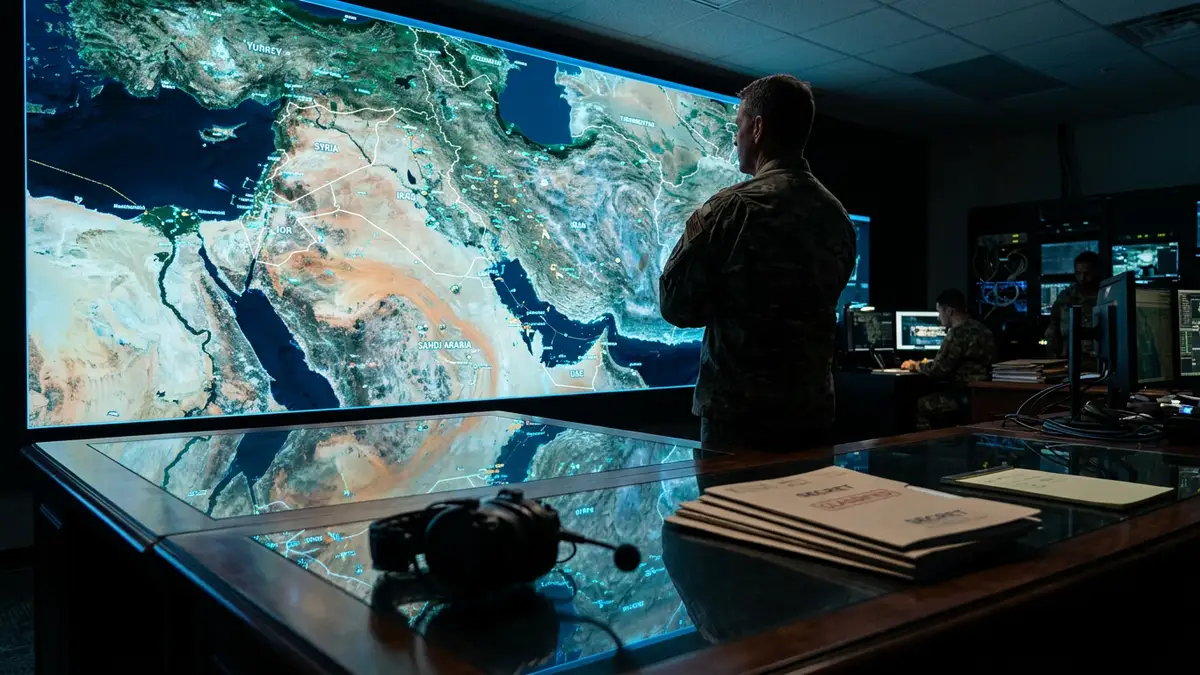
Image: Matt Weston / AI

Sarah Connor
The United States military has intensified its operational footprint across the Middle East as a sustained aerial campaign enters its third week, systematically dismantling Iranian military infrastructure.
Trump previously rejected British assistance and accused the United Kingdom of attempting to join wars already won. The current request for naval support marks a total departure from that isolationist posture.
Thirteen US service members have died in the theater of operations since the deployment began. The human cost of the mobilization continues to mount as operations expand.
Six personnel died in Kuwait, and one died in Saudi Arabia. Six crew members perished when a military refueling plane crashed in Iraq.
Gasoline prices across the United States have climbed steadily since the start of hostilities. Trump’s net approval ratings remain fixed despite the economic shift and the ongoing military engagement.
Marjorie Taylor Greene stated that Trump has betrayed his campaign promises of ending foreign wars. Internal political pressure from the president's inner circle intensifies as the conflict enters its third week.
This is Israel's war; this is not the United States' war
Tucker Carlson characterized the nature of the conflict as a proxy engagement rather than a direct national interest. 'This is Israel's war; this is not the United States' war,' Carlson said during a recent broadcast.
Tehran ordered Abu Dhabi and Dubai to clear their ports in anticipation of further military escalation. The tactical landscape shifted as Iran issued these urgent directives to regional commercial hubs.
Pete Hegseth reported that Mojtaba Khamenei was wounded and likely disfigured during a recent attack. Reports from the front lines indicate the Iranian leadership itself is under fire.
The Iranian regime previously stated it would set the entire region on fire if it faced a direct assault on its leadership or territory. This violence mirrors domestic events currently unfolding in Minneapolis.
Masked agents from Immigration and Customs Enforcement and Customs and Border Patrol killed two American citizens, Renée Good and Alex Pretti, in Minneapolis. The killings occurred during a period of heightened domestic security measures.
The Islamic revolution may attempt to destabilize the broader territory if the regime faces total collapse in the coming weeks. Some observers anticipate Trump will declare victory and withdraw forces once specific infrastructure targets are neutralized.
Nick Fuentes issued a series of inflammatory statements regarding the social order. He claimed that Jews run society and called for the imprisonment of Black people and the silencing of women.
The US military continues to reinforce its positions despite the lack of evidence regarding an imminent Iranian strike. Tehran’s military infrastructure remains the primary target of the ongoing joint aerial campaign.
The engagement draws comparisons to the rapid mobilizations of the 1991 Persian Gulf War. The lack of a clear casus belli has created a rift between the administration and its traditional isolationist base.
Insurance premiums for maritime transit have spiked as stakeholders in the global energy market monitor the Strait of Hormuz. The clearing of ports in the UAE signals a preparation for a total cessation of commercial traffic.
The aerial campaign continues to degrade Iranian command and control capabilities. A resulting power vacuum could trigger a decade of regional instability if the regime collapses.
Trump balances the demands of a high-intensity conflict with the domestic realities of an election cycle. The rising cost at the pump and the return of service members in caskets contrast with initial projections of a swift resolution.