US and Saudi Arabia Ink Landmark Nuclear Deal Amid Regional Tensions
Congressional Review Looms as Pact Reshapes Middle East Alliances and Nonproliferation Debates
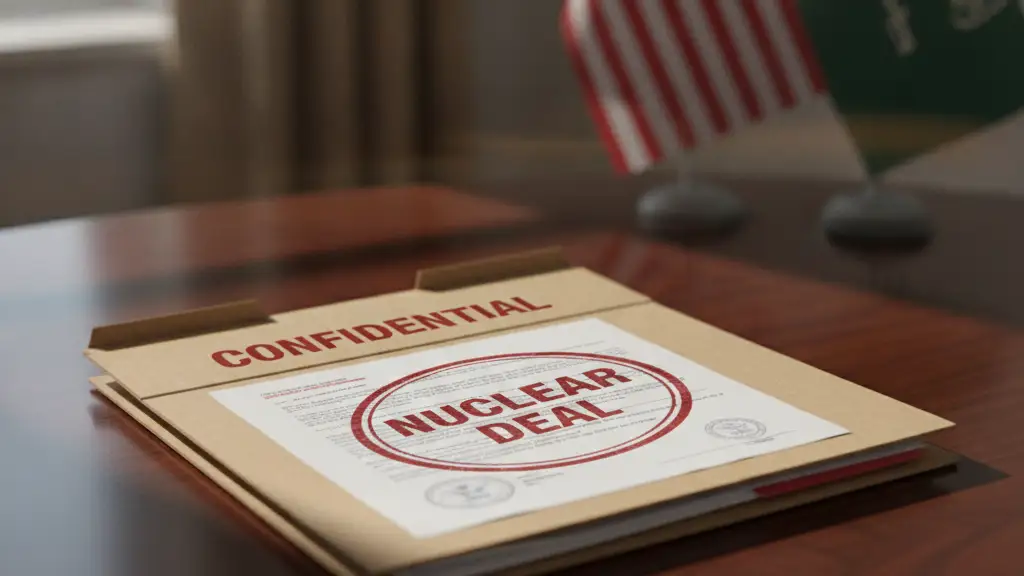
Image: Eddie Pollard / AI

Callum Smith
The United States and Saudi Arabia have announced a landmark nuclear deal, now submitted to the US Congress for review, marking a significant shift in geopolitical strategy.
Historically, the Middle East has served as a crucible of complex alliances and rivalries; nuclear ambitions frequently dominated strategic calculations, particularly after the 1979 Iranian Revolution.
The Abraham Accords, brokered by Donald Trump in 2020, previously secured normalization between Israel, the UAE, and Bahrain, fundamentally reshaping the diplomatic landscape with over $3 billion in new trade agreements.
However, the ongoing war in Gaza has reportedly destroyed the prospect of Saudi Arabia establishing formal relations with Israel, complicating broader regional peace efforts and stalling a potential $100 billion investment.
Donald Trump claims the nuclear deal hinges on Riyadh joining the Abraham Accords, which necessitates recognizing the state of Israel, a condition Saudi officials have publicly rejected without a Palestinian state.
The U.S. administration maintains the pact upholds high standards of nuclear safety and nonproliferation, a crucial assurance given the volatile geopolitical climate and the region's history of conflict.
The US-Saudi Arabia nuclear pact includes provisions addressing Saudi Arabia's potential for domestic uranium enrichment, focusing on nonproliferation safeguards to prevent weaponization.
It also incorporates a 'bilateral safeguards agreement' to ensure uranium enrichment capabilities serve solely civilian purposes, preventing weapons proliferation and ensuring energy security.
The deal allows Saudi Arabia to enrich uranium and process spent atomic fuel, a move contrasting with nonproliferation standards applied to other Middle Eastern nations, such as the UAE's 'gold standard' agreement.
Unlike the 2009 U.S.-United Arab Emirates nuclear accord, which mandated strict IAEA inspections, the US-Saudi deal requires neither normalization with Israel nor adoption of the IAEA’s strict Additional Protocol.
The agreement notably omits the International Atomic Energy Agency's Additional Protocol, a standard measure for enhanced verification of nuclear programs, a protocol adopted by 137 states.
Instead, the U.S. and Saudi Arabia themselves oversee safeguards, a historic arrangement that spans a 30-year duration, shifting oversight from international bodies.
This represents a significant shift in US policy towards Middle Eastern allies, moving away from previous nonproliferation precedents set with nations like South Korea.
Some Israeli politicians voice concerns, claiming Saudi Arabia could become a new nuclear threat in the region, with Knesset Member Gideon Sa'ar calling it 'a dangerous precedent'.
a dangerous precedent
Analysts suggest this nuclear pact with Saudi Arabia sends a clear signal: the US aims to keep regional allies in its fold, even if it means angering Israel and risking diplomatic fallout.
This move unfolds against a backdrop of escalating tensions; the US military launched its 12th successive night of strikes on Iran, targeting military capabilities in response to attacks on shipping.
The US claims these strikes hit maritime capabilities, missile and drone storage facilities, coastal surveillance sites, and air defense assets in Iran, causing significant damage.
Concurrently, Yemen’s Houthi militia attacked two Saudi Arabian oil tankers; one reportedly blazed in the Red Sea, further illustrating the region's fragility and economic vulnerability.
The Iran-aligned Houthi group confirmed its involvement, stating it attacked the two Saudi Arabian oil tankers in retaliation for Saudi-led coalition actions.
Meanwhile, House Republicans agreed to begin drafting a $95 billion bill to fund the war with Iran and provide aid to farmers, indicating a hardening stance against Tehran and a shift in legislative priorities.
The future landscape of the Middle East remains uncertain; this nuclear deal adds another layer of complexity to an already intricate web of alliances and conflicts, with potential long-term consequences.
Iran will likely argue America’s nuclear rules depend entirely on whether a country is an enemy, an ally, or a promising location for a Trump-branded development, citing perceived inconsistencies in US foreign policy and a double standard.