Planetary Parade Aligns Six Worlds Over the Horizon
Photographer Josh Dury Documents Rare Celestial Convergence Visible Through Early March
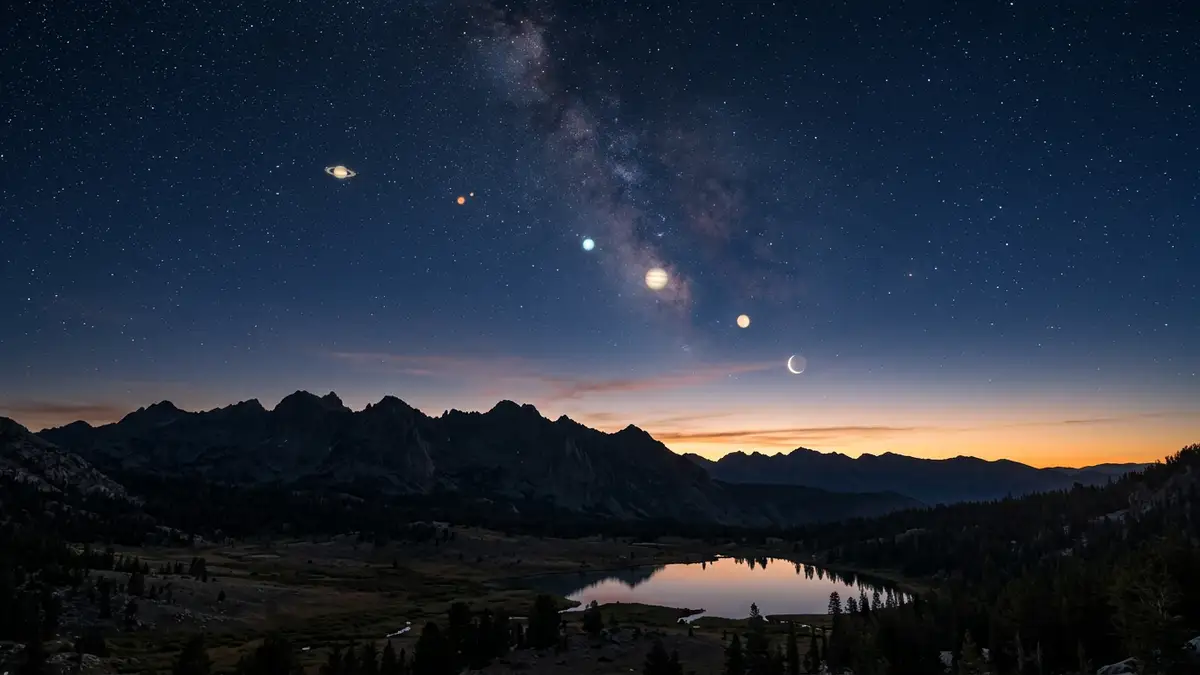
Image: Matt Weston / AI

Carla Rooney
A rare planetary parade has ignited the pre-dawn skies as six celestial bodies move into a linear alignment visible from Earth.
Photographer Josh Dury tracked the six planets as they transitioned into this precise, synchronized formation. The alignment reached its peak visibility around 28 February, marking a definitive moment for global astronomical observation.
Beyond the initial six-world cluster, Dury confirmed the Moon will also join this weekend's parade. This addition pulls a seventh major celestial body into the visual sequence for those watching the horizon.
Data from the Star Walk app indicates the planets appear most closely grouped on 28 February. This specific date serves as the primary focal point for observers attempting to view the entire cluster simultaneously.
This alignment follows a rigid historical pattern of orbital mechanics. Multiple planets now occupy the same quadrant of the sky from the perspective of Earth.
Stargazers and astronomical societies have tracked the movement of these six worlds for weeks. They appear as a distinct, sharp linear formation as they crest the horizon in the early hours.
The event draws intense scrutiny from both the scientific community and the public. Enthusiasts utilize specialized tracking software to time their viewing windows with mechanical precision.
Economic activity surrounding astrotourism often spikes during these specific celestial windows. Retailers report increased sales of telescopes and long-exposure camera gear as the public prepares for the event.
Dury utilized high-resolution equipment to freeze the motion of the planets against the void. The resulting images show the bright points of light as hard pinpricks against a stark, dark sky backdrop.
The six planets maintain their specific, varying orbital velocities throughout the event. To the naked eye, however, they appear as a static and organized row in the firmament.
Observers in the Northern Hemisphere hold the clearest vantage point for this specific grouping. The planets rise in the pre-dawn hours, requiring early rising for any chance of visibility.
The Star Walk app provides specific coordinates for locating the dimmer planets within the parade. Some of these worlds require binoculars or small telescopes to resolve clearly against the atmosphere.
Future celestial calendars mark this as a significant event in the current decade. It occurs shortly before the planets begin to drift further apart in their respective orbits.
Societal interest in these alignments has shifted over centuries. Ancient omen-seeking has been replaced by modern digital documentation and rapid data sharing across global networks.
The current parade includes a mix of gas giants and rocky inner planets. This variety allows for a diverse visual display of different planetary sizes and luminosities.
Dury’s documentation provides a physical record of the alignment. This data will persist long after the planets move out of their current visual synchronization.
The Moon's entry into the frame this weekend changes the composition of the alignment entirely. Those tracking the event over multiple nights will observe the shifting geometry of the lunar path.
Astronomical societies continue to monitor the progression as the planets move toward the edge of the visible cluster. The window for viewing the full six-planet line remains narrow and fleeting.
The alignment remains visible for a few days following the initial peak. Observers can continue to see the formation through the early days of March before the orbital paths finally diverge.